Administration & governance
One registry, and documents that stay findable
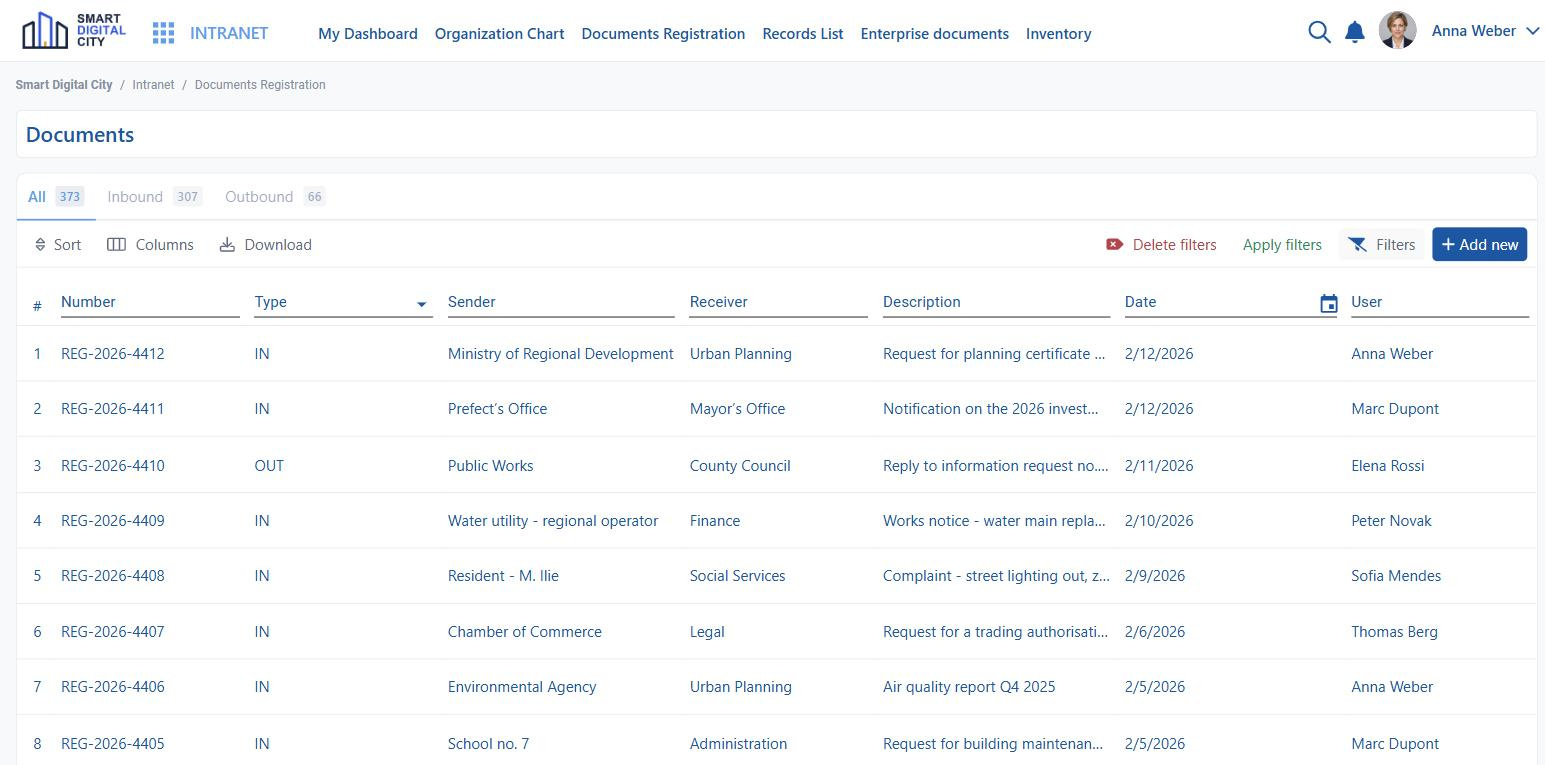
Incoming and outgoing correspondence, internal documents, versions, signatures and archive, in a single numbered register.
Why it matters
The memory of the administration, in one register
Registry is the memory of an administration. When it is a book, a shared drive and several inboxes at once, the memory is unreliable. One register, fed automatically by the processes that create documents, means what was received, produced, signed and sent can always be found — and proved.
Fed by the processes themselves
Documents are registered where they are created, not afterwards.
Received, produced, signed, sent
Each stage is part of the same entry.
Found, and proved
What exists can be located and demonstrated.
What it covers
Six things a register has to hold
Arrival, production, version, signature, classification and disposal — handled once, in the same place.
Incoming registration
Post, email, portal and counter, registered with a number and a date.
Outgoing documents
Produced from templates, signed, served, and recorded with proof of dispatch.
Versions
Drafts and final documents distinguished, with the version actually used identifiable.
Electronic signature
Qualified and advanced signatures, with validation stored alongside the document.
Classification
Files, subjects and retention periods applied at registration, not later.
Archive
Retention, transfer and disposal handled as a controlled process.
How it works
Registered, attached, signed, retained
The register is fed by the work itself, so nothing depends on someone remembering to file it.
01
Register on arrival
A scanned letter, an email or a portal submission all become registry entries with the same identity and the same clock.
02
Attach to the work
The document joins the case, the permit or the contract it belongs to, so it is found by context and not only by number.
03
Produce and sign
Outgoing documents are generated from templates and data, signed electronically, and dispatched through the recorded channel.
04
Retain and dispose
Retention periods run automatically; disposal is proposed, approved and recorded rather than improvised.
Outcomes
What changes
A register that is complete because it is filled by the process, not by goodwill.
Nothing arrives unregistered
Every channel lands in the same register.
Documents found by context
The permit, the case and the contract carry their own files.
Retention that actually runs
Periods are applied by the system, not by an annual clean-up.
Configured per administration
What is configured
- numbering schemes and registers
- the classification plan and retention periods
- document templates and who may use them
- signature levels required per document type
- dispatch channels and proof of service
- access rules between departments
- scanning, OCR and metadata capture
- archive transfer and disposal procedure
Connected to
The rest of the platform
- Every case, permit and contract that produces documents
- Qualified signature and timestamping services
- The citizen portal, for delivery to the applicant account
- Audit, which reads the registry as evidence
On your document flow
See registry on your own correspondence.
We take one week of incoming and outgoing documents, register them the way your procedure requires, and follow them to signature and archive.